• As we witness phenomena such as Momentum, Labour’s digital assemblage that pushed for Jeremy Corbyn in the 2017 General Election, we might want to remove digital activism out of commonplace. Beyond the rhetorics of the “phenomenon”, “social media-led change”, scholars have challenged the actual ICTs penetration in these activist realms by contrasting their relationship with digital capitalism. To what extent can they become bedfellows on what concerns commodification, immediacy, and “digital labour”? These are central questions for Veronica Barassi in Digital Activism on the Web: Every Day Struggles Against Digital Capitalism.

    This is an ethnography of three distinct groups of activists. First, she studies a UK-based initiative aimed at working for a positive image of Cuba, much connected to the UK left. The second is a young collective battling for better public spaces in Milan. And the third NGO is based in Madrid, to promote politicised ecological discussions.

    Barassi sees a gap in critical theories of the digital as they fail to address realistic settings. This could be solved by delving into the political roots of activists/users, inquiring into the self-referential language of the social networks. This failure at going deeper with what activists do, developing a closer look at their history and sense of strategy once on social media, for example. That could reverse the trend of having “thin” approaches to digital activism, as a “thick” approach would be one of more empiricism, cataloguing behaviours, mapping the real intention behind the use of digital assets in the everyday activism. To what extent participants are conscious not only of technologies, but of its implications, such as the evils from digital capitalism.

    Indeed, digital capitalism can be a rather controversial concept. Barassi resolves it by furnishing her activist ethnography with three stable notions. By assigning categories such as the “self-centred communication and individualism”, followed by the “user-generated data to profit”, which leads to a discussion on “digital labour”, we are guided through the principles of her exploration. Aware that these areas are also objects of unresolved disputes among scholars, Barassi opens these concepts to further interpretations. In dialogue with similar explorations of networked activism, as seen in Castells (2011) or, more recently, in Gerbaudo (2012), Barassi’s attempt to rethink some of such meanings seems more settled as a kind of anthropological perception.

    The author first focuses on activists’ self-projection through digital tools. The book skips normative divides such as the “new” and the “old”, “networked” or “non-networked” movements, as that would be to otherwise confirm a “thin” perception. Instead, We find the interesting idea of media imaginaries. While not necessarily connected with the digital capitalism discussion, we understand, for example, the reasons why a white-male group of activists from the UK has sought to transpose an “ideal” of Cuba to the heart of British politics. Crossing present, past, and future scenarios into the same media imaginaries appears as a key resource for them.

    Back to the digital problem, Barassi’s ethnography intends to avoid a techno-determinist approach. For that reason, details on activist organisations emerge here as a priority for the study, as well as discussions on their routines. This conscious focus on the “human” part to some extent contrasts when activists admit that the Internet has” radically changed every day practices” (54);  it does not get clear how exactly this came to happen or to what degree their role as ordinary Internet users coexists with that of activists, or if both remain the same.

    Barassi comes to later concede that activists switch between both receptors and participants of the technological agency.  However, likening activists’ opinion on technology with ideas of adoptions or concessions with the digital capitalism discourse seems a bit of a stretch. We risk to naturalise the action of corporate Internet giants, such as Google, by assuming that some of its interventions over people’s lives are not our concessions (browse on it, for example), while other actions (advertising, marketisation) are so. The premises according to which one considers what digital capitalism is and where it extends, how it is perceived, would need a bit more of development, under the risk of becoming too arbitrary.

    On the other hand, by interpreting the interplay between activism and digital life through ethnographic data, we learn that activists are prone to negotiate the technological agency along with other values. Technology is the advent that gives a contemporary shape to their gestures, but which does not affect a hard, long-standing political core. Barassi treats this duality very well by allowing the digital discourse to be a  “contested space of meaning” (60). At one level the role of the corporate web is expected and pictured by the activists, at another, this is about each user’s idea of what the digital means to their lives.

    Two final points approach the pressures from technology and its effects. The first one is about the “self-centred” nature of social media as an attitude-influencer. We realize that activists are rather critical of the “networked, individualist self” of the web, but that opinion seems to appear marginally, or on a case-by-case basis. In other words, activists might be self-centred, but a narcissist social media does not seem to affect collective processes of meaning and engagement, as they continue to acting as regular users.

    On digital labour, insofar as no real consensus exists on this controversial topic, this book does not seem to side with the “techno-optimist” theses. Whether by clicking and liking exists as a type of work or not, digital labour embodies a rather virtual concern to the activists. Regardless of the kind of digital labour we are talking about, participants argue on the creation of a different type of “value”. Eventually, this particular kind of labour will not necessarily follow a capitalist logic, rather, it resembles a  representational goal, aimed at mocking “social worlds”, not necessarily a sort of production system (96).

    As seen, activists’ accounts can inform the limits of the digital media usage, but it also sets the limits to scholars appropriation of this topic because it leads them to conform with much subjectivy from each user. Social movements’ action suggest much more complexity of terms such as digital labor, individualism, or immediacy than one would imagine. Therefore I wonder if an ethnographic approach is still what best suits this study. In reality, conversations have better worked to show that discussions on technology happen at a different pace when consumerism and technology are confronted with the activism reality. The book could have been slightly bolder by trying to translate other adoptions or refusals by activists, yet it shows a good use of the ethnographic when it focuses on purpose, rather than to confirm patterns for use of technology. 

    It is noteworthy that the author can give a fascinating account from the ground. By visiting meetings, closely talking to activists, or relating to their past or present experiences, Barassi creates a valuable set of data that is captured under non-spectacular, media-oriented circumstances. Pity that the constant reference to “capitalist” discourses seems to lack echo in many of the activists’ testimonials. Instead of “digital capitalism”, activists seem to cope with the pressures of a generic “digital mind-set”, which may rival their old principles and offline loyalties.

    The approach for activist magazines at the end of the book gives us a quick glance on how the legacy of struggle is far from being memorabilia. This part deserved to be further extended, perhaps by extracting more discourses from their past and comparing what we have in the present, if this doesn’t make another study. Overall, Barassi’s book has succeeded in demonstrating that, as far as activists acknowledge the pressures to adjust to a world of constant “new” digital capital, they also embody an ambiguous, slow-paced analogic side. In these negotiations, one must not assume that sides – pro or con – will be necessarily chosen. In that sense, Barassi’s book is a balanced and realistically grounded exercise.

    References

    Barassi, V. (2015). Activism on the web: Everyday struggles against digital capitalism. Routledge.

    Castells, M. (2011). The rise of the network society: The information age: Economy, society, and culture (Vol. 1). John Wiley & Sons.

    Downing, J. D. (2000). Radical Media: Rebellious Communication and Social Movements: Rebellious Communication and Social Movements. Sage Publications.

    Gerbaudo, P. (2012). Tweets and the streets: Social media and contemporary activism. Pluto Press.
  • While not officially part of the British Empire, interactions between Britain and Latin America have existed in reports, literary accounts, and detail-rich descriptions. Reading a variety of 19th century British writers, we find similarities in reports from many distinct countries that constitute what we call by Latin America; countries as distinct from each other as Mexico and Uruguay, Argentina and Panama, Brazil and Colombia. In British Representations of Latin America (University of Florida Press), we find an interesting model of sociological analysis of these accounts, without resorting to the traditional post-colonial, capitalist imperialism seen when looking at transatlantic relations.

    Ramirez starts by reviewing many of the shortcomings of these postcolonial, imperialism theories to explain why British interpretations of Latin America seem so unusual. On the one hand, capitalism theories have focused on trade in colonial times, much embedded in Marxism values, which fail to see implications that lie beyond the much quoted “dependence” theory. For example, these theories would forget the role of British commerce had for the struggle for the region’s independence, which comes down as a relatively positive outcome, let alone all the collaborations that foreign traders received from natives, and local elites.

    41mHwueHBSL._SX314_BO1,204,203,200_

    On the postcolonial side, Ramirez sees writers such as Césaire as “romanticizing” Latin America, as much as the “dependence” theory did. Yet, here authors have oversimplified the local context, where “no conflict” existed before the European conquest. Said’s Orientalism is reviewed more positively in that sense, particularly because it fits in very well to understand British colonial narratives. Despite British presence in Latin America appears as less aggressive than in India, for example, though “more risk-sensitive”, Said’s inclination to portray power lays a good foundation for this study, especially in what touches the Foucauldian articulations of power through the discourse.

    We are introduced to what Ramirez calls as the Americanist discourse, the colonial view developed by the British on Latin America. Following the next chapters, we find key case studies. Ralegh’s Discovery of Guiana, Conrad’s Nostromo, Conan Doyle’s The Lost World, Lowrey’s Under the Volcano, and Greene’s work on Mexico, Argentina and Panama. They will subside a discussion that brings about more than “cultural bearing”, that is, despite being novels, some of them ficcional reports, they are also embedded in the complexity of commercial relations between Britain and Latin America of the time. It is not about escaping the image of the “barbarian vs the civilized”, but these texts will reveal much of the post-imperial mood in Britain as the Empire starts its decline at the late 19th century.

    We see, for instance, the extent to which Ralegh’s and Schomburgk’s travels across Guiana have brought much of its enthusiasm from the Armada victory against the Spanish. Yet, how Schomburgk’s search for the place of British Empire amid the “savages” of the Amazon. Both are accounts that end up being more about Britain than about Latin America. Not much distant from this, Conrad’s characters have mirrored the late development of the Andean region, but also invites the inevitable “cynicism” with which he sees the dubious role of foreigners in the country’s stabilization. Doyle’s regard to Brazil and the Amazon bears ties with Darwin’s evolution theory and its naturalization of colonizing practices (“beating the natives”, p. 109), but witnesses much of the problematic adaptation of foreigners to the new tropical reality.

    The most interesting part of Ramirez’s detailed exploration dwells on the links with metropolitan publications, namely The Review of Reviews, the London-based tabloid. Plenty of satirical views of Britons in the region came out in the tabloid, some of which mirroring prejudice and humor. Not less sensationalist, Conrad’s Heart of Darkness and Doyle’s The Lost Word stressed the consequences of the British man’s expeditions around the world; in Latin America this gets supernatural tones of shock with nature, the dangers of bureaucracy and corruption among the barbarians. Greene’s The Lawless Roads adds “irritation and boredom” to it, as it quotes the “mañana, mañana” jargon (tomorrow things will be ready) (p. 151).

    The merit in critically engaging with such Americanist narratives is that of recognizing what lies behind the literary interpretations from the Empire, whether on Asia and Africa, but which, on Latin America, assume features of its own. It is a “literary conversation” on key themes such as development and trade (p. 169), but which imports folklore and mysticism, unveiling insecurity of Britain’s attempts to engage with the wider world on a non-extractive, classic colonial basis (at least directly). There was a need for the country to launch such expeditions, and much of the disillusion appears in the way Latin America is portrayed as the “disappointing” endeavor, the failing region in the extent of risky commercial partner, which is an impression that stretches over other subjects.

    At one level, it is a discourse that fits well in a context of Britain intellectual expansionism to readers back home, partly based on academic interest, as seen in the example in Darwin’s goals of collecting species from around the world, but partly mundane as a pub chat. At another level, that effort is articulated within a new modernist look to the outside, as writers do not get rid of old “civilizing” ideas, which results in their own detachment and poor self-assessment of what “being foreigner” means, a dismay to the outer world that may last to this day.

    At the end, Ramirez aims to continue the conversation by citing films that follow this Americanist orientation in contemporary times. And yet, there lies a missed opportunity in this book. Ramirez falls short of developing about Americanism in the aftermath of the British Empire, which could appear interesting to discuss in a time of declining British presence in Latin America.

    To what extent could the Americanist discourse reside in Britain’s loss of influence, if not, isolation, in contemporary affairs? How could this framework serve a more ambitious narrative that leads, if not only to indifference, to a certain ignorance? The look at the Americanist narratives as a framework on its own versus its post-colonial implications could also deserve further reviews as the post-structuralism and the preoccupation with language loses popularity in academia, opening space to the political correct.

    In any case, British Representations of Latin America achieves a good deal of empirical research regarding an often-dismissed relationship, as it comes as an alternative way of looking at colonial mind set. It confirms neither the hegemonic British look of authority and knowledge, nor the victimizing position that Latin America may assume in post-colonial studies, as hegemonic relations carry far more complexity.

  • To pay homage to the world’s indigenous communities, the Biennale creates unnecessary mysticism

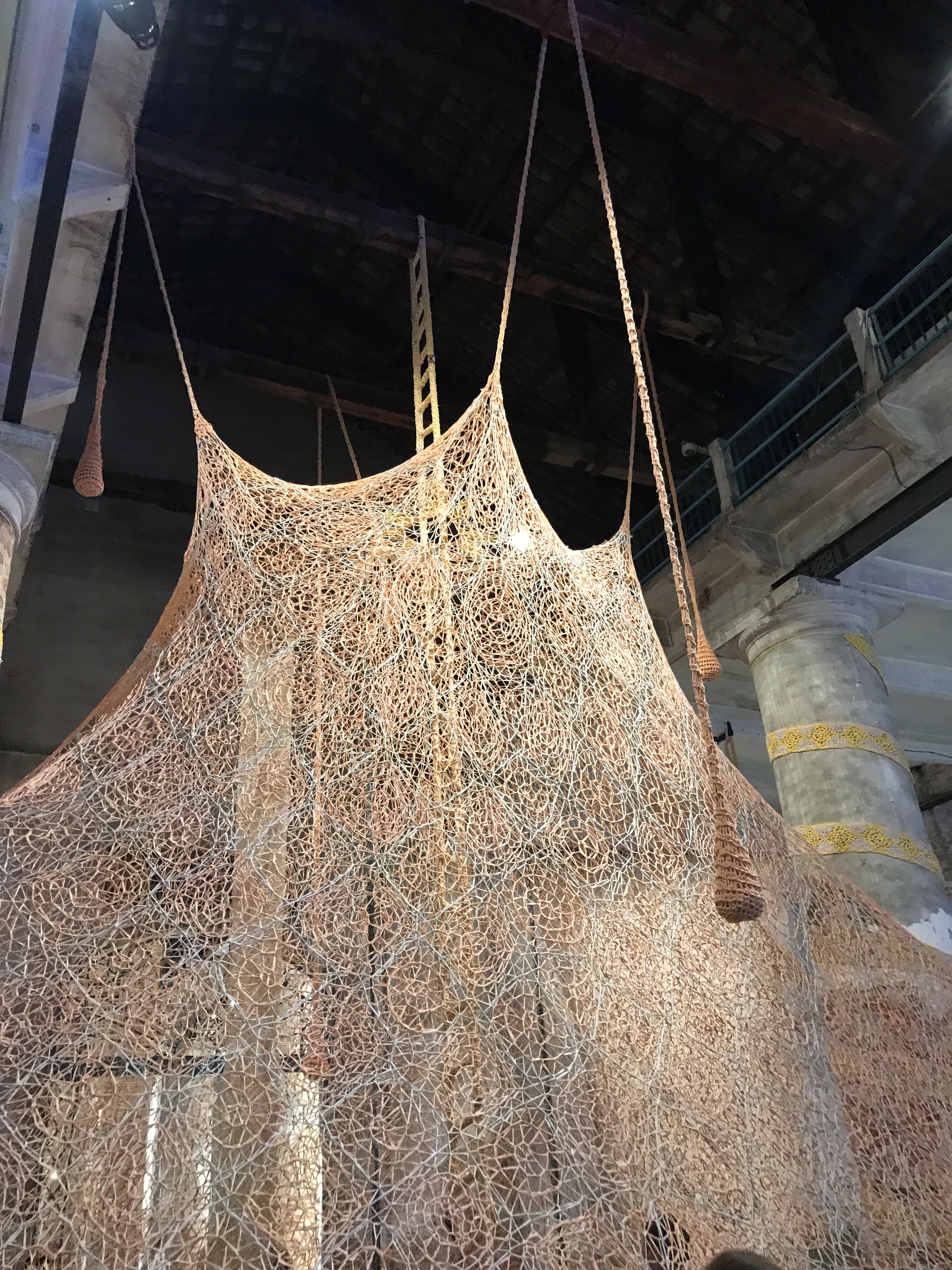
    The 57th Venice Biennale decided to dedicate a large pavilion of its Arsenale section to the art of native communities around the world. An example of this incursion is the large embroidered hut designed by Brazilian artist Ernesto Neto, entitled “Um Sagrado Lugar” or A Sacred Place. Neto’s original proposal was not only to debate shamanism by reconstructing a type of dwelling found in the Amazon forest, as he also invited a few members of a tribe to the show’s opening, straight from north Brazil. At the occasion, a few members of the community spoke with the artist, as they performed rituals in circles, sang typical songs.

    One month later, whoever visited the Arsenale would see a slight diversion from the “sacred place”. In fact, what old shamans took millennia to protect and cultivate, one Biennale is enough to turn it mainstream and consumerist. The layout of Neto’s installation is still the same, but the mystery and the genuine performance of the indigenous culture now appears as a mere object for thousands of visitors’ appreciation, who have gone through the gigantic exhibition. Would these visitors care if they are seeing Appalachian art, or Masi art, or Dengese art? They would be all branded as native and that is fine.

    That means that the indigenous hut was nothing more than shelter for children and their parents, as millenary songs were now entertaining the crying babies. In brief, Neto’s curation of indigenous art, brought here for being authentic, was the delight of foreigners in their sightseeing vacation programme. While fitting well into the Biennale’s proposal, the problem is whether his pieces could still bear any relation to the indigenous people, whose cultures curators vow to defend and revive.

    It is not the case of vilifying Neto for his sincere interest in importing the unknown from Brazil to international stage, which would inevitably produce a commodity. This is not the point. The problem behind opening what ethnic minorities do in their native lands in this way, alongside selling their rituals as ready-made (useful enough for the “world” gaze and re-enactment) is at the limits of this ambition, and at the generic frame adopted by artists and curators alike.

    There is a breaking point between the revival of what once was genuine, as found at its birth place on one side, and the legitimisation of the fake, on the other. One thing is the religious and reverent side of shamanism, another thing is the irony and mockery as result of its exhibition and foreign reconstruction. The question is whether Neto’s attempt to talk indigenous to this audience adds anything in their consideration (or knowledge) for the ancestral non-Western cultures, therefore, then generalising the crushed indigenous history in the West. That question would apply to the entire pavilion and the event’s bona fide will in general.

    On the other hand, it is also important to recognise that other artists in this Biennale have also developed a sincere relationship with all things indigenous. For them, what was really at stake was the critique, while still a comfort zone, gave visitors more things to consider. Juan Downey’s work, for instance, is more sensitive to the mediatisation of the indigenous as of Latin American culture and politics. Downey places old TV sets in circle broadcasting what seems to be indigenous ceremonies continuous programme, which includes images of Chile’s colonial and authoritarian past, as if they belonged to the same context of colonisation and power. Although not putting it in that way, Downey’s repertoire is doubtlessly aware of the limitations to portray the indigenous, which is for a great deal of the population media images only.

    Indeed, the very problem of ‘going native’ at the Biennale lies in the extent to which artists do recognise mediatisation as their take when moving forward on this subject. Amid droves of tourists circulating in the legendary city, the question is less who-did-what-and-where, and even lesser about playing the political correctness card, and more about the de-politicisation of others’ culture. Shall artists, such as Neto, still try to broker the objective presence of such distant, imaginary environment on this stage, or should they deliver artistic, intellectual, or creative analysis or critique of how indigenous materiality has been appropriated, sold, destroyed, and imitated by the “white man”?

    Less ambitious works have invested in the second hypothesis. Artists have created beautiful pieces in which indigenous or colonial memories do not try to play the spectacle for the audience and do the “such extraordinary thing”. Abdoulye Konaté’s produced a large textile piece named Brésil (Guarani). Konaté has travelled across Southeast Brazil to re-connect what he found as similarities between the art produced by Brazil’s tribes with that of his native Mali. The result is a multicolour fabric piece starting from tones of indigo, but converging into a full variety of other tones. It is about recognising the variations of a same culture when forcedly or spontaneously seeded in multiple sites.

    Another example exists in Nicolás Garcia Uruburu, from Argentina. In a work originally shown in the 1970s, Uruburu painted everything in green, colouring the many canals and old buildings in Venice. As far as the core of his interventions is purely at designing a new environment and an echo from ecologist movements, it has also encapsulated a fundamental debate on colonisation and de-colonisation as change, mix, or otherwise, conservation, without raising an eyebrow by manipulating ancient cultures on their iconic value. He has crafted his own icons to talk about changing others’ environments.

    Thus, no shock effect is necessary to bring the powerful and powerless, victims and agents closer. While vocal on art that aims to revenge against colonialism, the shamanic in the Venice Biennale sets another return to the visually exotic, but comfortable enough for the likes of European audiences, cuddling each artists’ ego as both victim and protagonist. Part of this agency is creating a new modern, international traveller indigenous, but which, otherwise, drives visitors away from the state of preservation into a state of trivialisation.

    To wrap it up, it is not a matter of artistic cynicism only, but of ignorance. By not granting visitors a chance for self-criticism, particularly regarding the century-old European voyeurism to the disadvantaged natives (as everyone is native at some point), curators seemed to privilege interpretative, mockery art on top of the real thing. It is if the real thing could not exist without mediation, let’s say it. The same problem seen decades ago in Magiciens de la Terre, the controversial French exhibition. That had given us so much to think about in the last decades. In brief, it told us that there is no need to invite shamans if curators are the first ones to create mysticism and alienation.

  • Dom Helder

    It is impressive how the situation has changed in Brazil’s favelas over the last decades. In the 1950s, it was common to find bishops and other charismatic leaders brokering dialogue between favela dwellers, mainstream society, and the state. They used to ask authorities for food support, or helped to halt evictions, often protesting police violence. There was a need to appropriate the favela people’s voice for their own benefit.

    Indeed, the above picture is particularly powerful to show the dependence of favela populations to external mediators. It portrays the Bishop Dom Helder Câmara visiting one of Rio’s most famous favelas, Rocinha, illustrating what was an original report by O Globo newspaper. He was then a popular Catholic Church authority who grew to prominence for his work for the poor and his resistance after the 1964 coup.

    As far as Câmara was well intentioned and successful in championing social policies, in this picture we see in his gesture a mix of compassion and charisma, nothing is compared to today’s ability of favela dwellers of self-mediatising their thoughts. Through blogs and social media, they can develop a new image of independence, aligning their presence to that of mainstream media characters.

    Weighing in all limitations that stem from the use of new media, and there are many, that is to show that besides the staggering poverty that still strikes today’s favelas, it is possible to improve the situation by – at least- giving the locals ways in which they can communicate and appear to the wider world with their own faces and language.